
Wild Species In India
Rhino
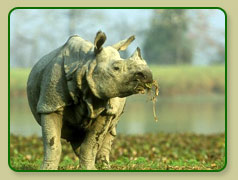 The
Indian Rhinoceros (Rhinoceros unicornis) is also called Greater
One-horned Rhinoceros and Asian One-horned Rhinoceros and belongs to the
Rhinocerotidae family. Listed as a vulnerable species, the large mammal
is primarily found in parts of north-eastern India and in protected
areas in the Terai of Nepal, where populations are confined to the
riverine grasslands in the foothills of the Himalayas. Weighing between
2260 kg and 3000 kg, it is the fourth largest land animal and has a
single horn, which measures 20 to 57 cm (7.9 to 22 in) in length.
The
Indian Rhinoceros (Rhinoceros unicornis) is also called Greater
One-horned Rhinoceros and Asian One-horned Rhinoceros and belongs to the
Rhinocerotidae family. Listed as a vulnerable species, the large mammal
is primarily found in parts of north-eastern India and in protected
areas in the Terai of Nepal, where populations are confined to the
riverine grasslands in the foothills of the Himalayas. Weighing between
2260 kg and 3000 kg, it is the fourth largest land animal and has a
single horn, which measures 20 to 57 cm (7.9 to 22 in) in length.
The Indian rhinoceros once ranged throughout the entire stretch of the Indo-Gangetic Plain but excessive hunting reduced their natural habitat drastically. Today, about 3,000 rhinos live in the wild, 2,000 of which are found in India's Assam alone.
General information
There are five kinds of Rhinos found in the world :
The
Indian Rhinoceros (Rhinoceros unicornis) is also called Greater
One-horned Rhinoceros and Asian One-horned Rhinoceros and belongs to the
Rhinocerotidae family. Listed as a vulnerable species, the large mammal
is primarily found in parts of north-eastern India and in protected
areas in the Terai of Nepal, where populations are confined to the
riverine grasslands in the foothills of the Himalayas. Weighing between
2260 kg and 3000 kg, it is the fourth largest land animal and has a
single horn, which measures 20 to 57 cm (7.9 to 22 in) in length.The Indian rhinoceros once ranged throughout the entire stretch of the Indo-Gangetic Plain but excessive hunting reduced their natural habitat drastically. Today, about 3,000 rhinos live in the wild, 2,000 of which are found in India's Assam alone.
General information
- Weight: 1,800 - 2,700 kg (4,000 - 6,000 lbs)
- Height (at shoulder): 1,75 - 2 m (5,75 -6,5 ft)
- Length (head and body): 3 - 3,8 m (10 - 12,5 ft)
- Horn length: 0,20 - 0,60 m (8 in - 24 in)
- Lifespan: 40 to 50 years
- Characteristics: only one horn and skin with large folds all over its body.
There are five kinds of Rhinos found in the world :
- Indian Rhino
- White Rhino
- Black Rhino
- Javan Rhino
- Sumatran Rhino
- Indian Rhinos may reach speeds of 40 km/h (25 m/h) and are extremely good swimmers.
- Indian Rhinos are primarily solitary except for the females when they have a calf.
- Indian Rhinos have home ranges of 2-8 square kilometers in size.
- Males are loosely territorial.
- Indian Rhinos feed during the morning and evening and spend the afternoon wallowing in lakes, rivers and ponds.
- Indian Rhinos are primarily grazers but occasionally also browse.
- Indian Rhinos prefer wetlands and also are known to feed on aquatic plants while in the water.
 Rajasthan Camel Safari Tours
Corbett Wildlife Tours
North East Wildlife Tours
Wildlife with Taj Mahal Tours
South India Wildlife Tour Package
Rajasthan Wildlife Holiday
Tiger Safari Holiday
Luxury India Wildlife Tours
India Nepal Wildlife Tour
Ranthambore National Parks Tours
Bandhavgarh National Park Tour
Wildlife Photographic Tours To India
Tiger Tour packages
Kerala Wildlife Tour
Rajasthan with Wildlife Tours
Taj Mahal Agra & Ranthambore Tiger Tour
Rajasthan Camel Safari Tours
Corbett Wildlife Tours
North East Wildlife Tours
Wildlife with Taj Mahal Tours
South India Wildlife Tour Package
Rajasthan Wildlife Holiday
Tiger Safari Holiday
Luxury India Wildlife Tours
India Nepal Wildlife Tour
Ranthambore National Parks Tours
Bandhavgarh National Park Tour
Wildlife Photographic Tours To India
Tiger Tour packages
Kerala Wildlife Tour
Rajasthan with Wildlife Tours
Taj Mahal Agra & Ranthambore Tiger Tour
